
Best Travel Blackout Blind 2026: Do You Actually Need One?
By BabyTravel UK Editorial Team · Last updated July 2026
If there's one product that comes up again and again in conversations about holidaying with a baby, it's the portable blackout blind. Parents who've travelled without one — and endured a 5am wake-up from a sun-flooded cottage bedroom — tend to be evangelical about them afterwards. But are they genuinely essential, or is it clever marketing for a problem that doesn't really exist? This guide gives you an honest answer, then walks you through the best travel blackout blinds on the UK market in 2026.
Quick Takeaways
- ✅ Most parents need one — especially for summer UK or European holidays with a baby under two
- 💡 The Tommee Tippee Sleeptight is the market leader for good reason — reliable, effective, and packable
- 💸 Budget option: Magic Blackout static cling film (around £10) works almost as well for a fraction of the price
- 🆘 Emergency option: black bin bags + gaffer tape. Looks terrible. Works brilliantly.
- 🔇 Pair it with white noise for the most effective holiday sleep environment

A well-fitted portable blackout blind transforms even the most light-filled cottage bedroom into a proper sleep space.
Do You Actually Need a Travel Blackout Blind?
The honest answer is: probably yes. Here's why the numbers stack up against you without one.
In the UK, sunrise in June arrives before 5am. Many cottage curtains are decorative rather than functional — thin linen, pale lining, or no lining at all. Holiday park chalets and caravans are even worse. Hotels sometimes have blackout curtains, but the gap down the middle lets in a sword of light at precisely cot level. Abroad, Mediterranean shutters are good — but slatted shutters, jalousies, and shutterless rooms are common, particularly in rural accommodation.
Your baby's sleep environment at home almost certainly has more darkness than any of these. And sleep research consistently shows that even low-level light — particularly in the blue spectrum of morning light — suppresses melatonin and triggers waking. If your baby is under two, their circadian rhythm is still developing, and light has a powerful effect on when they decide the day has started.
The portable blackout blind is, consistently, the single highest-impact travel item parents report on this site and across UK parenting forums. More than white noise. More than a familiar sleeping bag. The darkness comes first. Pair it with your baby's usual sleep routine and you've done most of the hard work.
When You Might NOT Need One
📋 Free Baby Holiday Packing Checklist
Enter your email and we'll send the free printable checklist straight to your inbox — every category, ready to tick off before every trip.
There are genuine exceptions where a blackout blind adds little value:
- Newborns (0–6 weeks) — very young babies haven't yet developed a circadian rhythm. They'll sleep in most conditions, day or night, light or dark. Save your money until they're old enough to be light-sensitive.
- Winter trips (November–February) — when UK sunrise is after 7:30am and it's dark by 4pm, most accommodation curtains are adequate. The risk is low.
- Accommodation with confirmed solid shutters — a thick-walled farmhouse with proper wooden shutters that close flush can be genuinely dark. Ask specifically before you decide to skip the blind.
- That rare baby who sleeps regardless of light — some parents are genuinely blessed. If your child has slept through bright mornings at home, you may be fine. You know your baby better than any guide does.
Our Tip: Even if you think you might not need one, it takes up almost no space in your bag. A packable blackout blind weighs less than 200g and fits in a small pouch. The downside of bringing it unnecessarily is trivial. The downside of needing it and not having it is a week of 5am starts.
Do You Need One? Quick Reference
| Your Situation | Need a Blackout Blind? |
|---|---|
| UK cottage or self-catering, spring or summer | ✅ Yes — cottage curtains are rarely dark enough |
| Caravan or holiday park chalet | ✅ Yes — thin walls and thin curtains, every time |
| Hotel room (UK or Europe) | ✅ Probably — hotel blackout curtains vary wildly |
| Mediterranean villa or apartment | ✅ Often — shutters help but aren't always light-tight |
| Baby aged 0–6 weeks | ⚠️ Less critical — circadian rhythm not yet set |
| Winter trip (Dec–Feb) in the UK | ⚠️ Probably not — short days do the job for you |
| Accommodation with confirmed solid shutters | 🤔 Maybe not — worth asking before deciding |
The Best Travel Blackout Blinds in 2026
There's no single "best" blackout blind for all situations — the right pick depends on your window type, your budget, and whether you want to block the window or cover the cot. Here's how the main options compare.
1. Tommee Tippee Sleeptight Portable Blackout Blind — Best Overall
This is our pick and the product you'll see recommended across virtually every article on this site. The Sleeptight uses a combination of static cling and suction cups to attach to most glass surfaces without tools or adhesive. It comes in two sizes to cover different window dimensions, and the blackout fabric is genuinely effective — not the thin, light-filtering kind.
The main limitation is fiddly installation on non-standard windows. Cottage windows with small panes, bay windows, or angled sash frames can require some creative repositioning. Give yourself 15 minutes to install before your baby's first nap in a new place, not five minutes while they're already rubbing their eyes. It packs into its own carry pouch and weighs around 175g.
Best for: most parents as an everyday travel essential. See our full product card below.
2. SnoozeShade Pram Blackout Covers (For Naps on the Go)
A different approach altogether — rather than darkening a room, the SnoozeShade clips over the front of your pram or pushchair to create a dark, breathable space so your baby can nap while you're out and about. It's the answer for daytime sleep away from the accommodation: sightseeing, at the beach, walking a fractious baby down, or anywhere a bright pushchair keeps them wide awake. The air-permeable blackout fabric blocks the vast majority of light while staying well ventilated, and it adds UPF50+ sun protection as a bonus. It won't help with a 5am bedroom sunrise — for that you still want a window blind — but for naps on the go it earns its place in the changing bag.
SnoozeShade makes two sizes worth knowing. The Original fits most prams when your baby is lying flat or reclined — ideal for the newborn and younger-baby months. The Plus Extra is larger and shaped for older babies and toddlers who sit more upright, extending down over the footwell for fuller coverage. Both are around £25–£35.

SnoozeShade Original
At a glance: A breathable pram blackout cover for daytime naps on the go — best for younger babies lying flat or reclined.
Clips over the pram hood to create a dark, ventilated space so your baby can sleep while you keep moving. Air-permeable blackout fabric, UPF50+ sun protection, and it packs down small enough to live in the changing bag. Best suited to the newborn-to-around-6-months stage when your baby naps lying back. Priced at around £25–£35.
- ✅ Gets babies to nap out and about — beach, sightseeing, walks
- ✅ Breathable blackout fabric with UPF50+ sun protection
- ✅ Packs down small — fits in the changing bag
- ❌ Best for younger babies lying flat — sized for reclined use
- ❌ A pram nap aid, not a room or window blackout
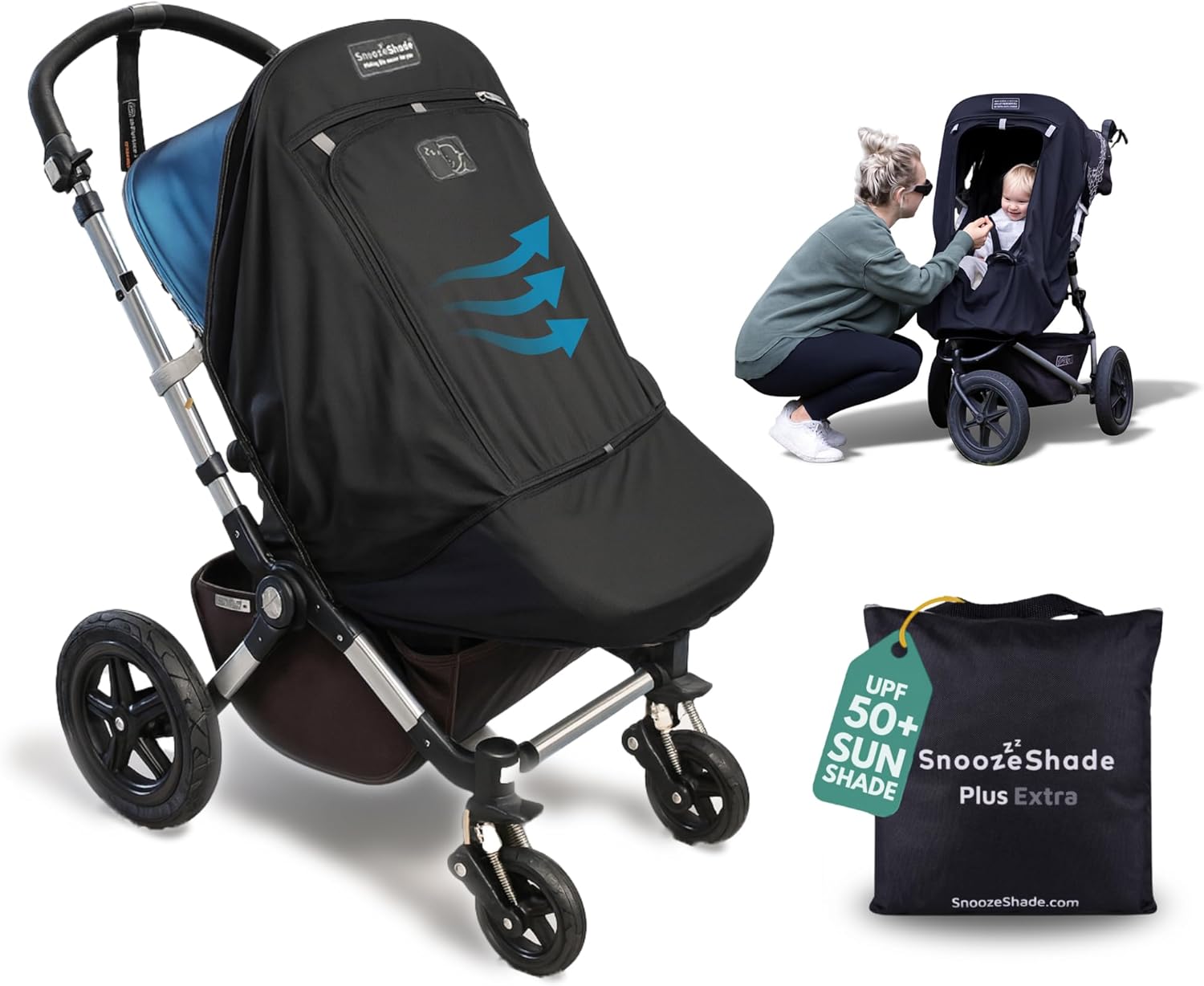
SnoozeShade Plus Extra
At a glance: The bigger version of the Original, shaped for older babies and toddlers who sit upright in the pushchair.
Same breathable blackout fabric and UPF50+ protection as the Original, but with a taller, deeper cut that covers a more upright pushchair seat right down to the footwell. If your baby has grown out of napping flat and now sits up to watch the world, this is the size to buy. Around £25–£35.
- ✅ Sized for upright pushchairs — suits older babies and toddlers
- ✅ Deeper coverage to the footwell for fuller darkness
- ✅ Same breathable blackout fabric and UPF50+ rating
- ❌ Larger to pack than the Original
- ❌ A pram nap aid, not a room or window blackout
3. Magic Blackout Blind (Static Cling Film) — Best Budget Pick
The Magic Blackout Blind is a roll of opaque static-cling film — you cut it to size, smooth it onto the glass, and it adheres without suction cups or adhesive residue. Around £8–£12 for a large roll (enough for multiple trips). It's surprisingly effective — the cling holds well on clean, smooth glass — and the main advantage is cost and packability. A small roll fits in your washbag.
The downsides: it can look a bit rough around the edges, it doesn't work on frosted or heavily textured glass, and removing and reapplying it multiple times over a holiday degrades the static cling. For families who travel frequently, the Tommee Tippee is worth the extra spend. For a one-off trip, this is a genuinely excellent budget option.
4. Bin Bags + Gaffer Tape — The Emergency Option
Not a product recommendation — but an honest one. If you've forgotten your blackout blind and you're facing a 5am summer sunrise, two black bin bags taped around the window frame with gaffer tape (or even masking tape) will block light effectively. It looks absolutely ridiculous. It works. Bin bags are available in every UK supermarket and most European convenience stores.
If you're camping or glamping, this is often your best practical option anyway — suction cups won't work on canvas or fabric. Leave the bin bags behind when you depart and you haven't wasted anything.
5. SlumberPod Portable Sleep Canopy — Best for Full Darkness Over the Cot
The SlumberPod takes a different route to the window blinds above: instead of darkening the room, it darkens the cot itself. It's a breathable blackout canopy that stands over a travel cot or toddler bed, creating a private, dark sleep space regardless of how light the rest of the room is. That makes it the go-to for families sharing one room with their baby — you can keep the lights on, watch TV, or get ready for bed while your baby sleeps in genuine darkness a few feet away.
It's the priciest option on this page at around £150, and it's bulkier to pack than a window blind — this is a considered buy for frequent travellers or room-sharing families, not a casual add-on. But for hotel rooms, open-plan holiday lets, and grandparents' spare rooms where you simply can't make the whole room dark, nothing else here solves the problem as completely. A vent at the top and mesh panels keep air moving, and it fits most standard travel cots.

SlumberPod Portable Sleep Canopy
At a glance: A blackout canopy that darkens the cot itself — ideal when you can't make the whole room dark, especially for room-sharing families.
Stands over a travel cot or toddler bed to create a fully dark, private sleep space no matter how light the surrounding room is. Breathable mesh panels and a top vent keep air moving, and it fits most standard travel cots. The premium option here at around £150.
- ✅ Creates genuine darkness over the cot, not just the window
- ✅ Perfect for sharing one room with your baby
- ✅ Breathable mesh panels and top vent for airflow
- ✅ Fits most standard travel cots
- ❌ Much pricier than a window blind (~£150)
- ❌ Bulkier to pack — a considered buy, not a casual extra
6. Koo-di Sun & Sleep Cover — Budget Cot Shade for Light Naps
The Koo-di Sun & Sleep Cover is a lightweight breathable cover that shades a travel cot to soften bright light and help babies settle for daytime naps. It's a cheaper, more packable middle ground between a full canopy and a window blind — useful for a garden nap, a bright conservatory, or a holiday room where you just want to take the edge off the light rather than achieve total darkness.
Be clear on what it is, though: it's a shade and privacy cover rather than a true blackout, so it won't deliver the pitch-dark of the SlumberPod or a well-fitted window blind. For light-sensitive babies at 5am it won't be enough on its own. But as an affordable, breathable way to dim a cot for naps, it does a genuine job for a fraction of the price.

Koo-di Sun & Sleep Cover
At a glance: A budget, breathable cot shade that dims bright light for naps — not a full blackout, but easy to pack and cheap.
A lightweight cover that shades a travel cot to soften daylight and offer a little privacy, helping babies settle for daytime naps in bright rooms or the garden. Breathable and packable, it's the affordable middle ground between a full canopy and a window blind. Around £15–£20.
- ✅ Cheap and very packable
- ✅ Breathable — softens bright light for naps
- ✅ Handy for gardens, conservatories, and bright rooms
- ❌ A shade, not a true blackout — won't beat a 5am sunrise alone
- ❌ Less dark than the SlumberPod or a fitted window blind
Product Comparison Table
| Product | Attachment | Darkness | Packed Size | Ease of Use | Price | Our Rating |
|---|---|---|---|---|---|---|
| Tommee Tippee Sleeptight | Suction cups + static cling | ⭐⭐⭐⭐⭐ | Small pouch | ⭐⭐⭐⭐ | ~£20–£25 | Our top pick |
| SnoozeShade Original (pram cover) | Clips over pram hood | ⭐⭐⭐⭐⭐ | Small pouch | ⭐⭐⭐⭐ | ~£25–£35 | Best for naps on the go (younger babies) |
| SnoozeShade Plus Extra (pram cover) | Clips over pushchair | ⭐⭐⭐⭐⭐ | Small pouch | ⭐⭐⭐⭐ | ~£25–£35 | Best for naps on the go (upright toddlers) |
| Magic Blackout Static Cling Film | Static cling to glass | ⭐⭐⭐⭐ | Tiny roll | ⭐⭐⭐ | ~£8–£12 | Best budget option |
| Bin bags + gaffer tape | Tape to frame | ⭐⭐⭐⭐ | Negligible | ⭐⭐⭐ | ~£2 or free | Emergency/camping use |
| SlumberPod (cot canopy) | Stands over the cot | ⭐⭐⭐⭐⭐ | Bulky bag | ⭐⭐⭐⭐ | ~£150 | Best for room-sharing / full darkness |
| Koo-di Sun & Sleep Cover (cot shade) | Covers the cot | ⭐⭐⭐ | Small pouch | ⭐⭐⭐⭐ | ~£15–£20 | Budget shade for naps |

Tommee Tippee Sleeptight Portable Blackout Blind
At a glance: The most-recommended portable blackout blind for UK travelling families — and for good reason.
Attaches to most window types using a combination of static cling and suction cups, with no tools or adhesive required. Comes in two sizes to fit different window widths, packs into its own compact carry pouch, and delivers genuine blackout-level darkness rather than just light reduction. The price sits around £20–£25.
- ✅ Genuinely effective light blocking
- ✅ Packs flat — light and compact
- ✅ Works on most smooth glass surfaces
- ✅ Available in two sizes for different windows
- ❌ Can be fiddly on non-standard or multi-pane windows
- ❌ Suction cups less reliable on cold or frosted glass
How to Use a Portable Blackout Blind Effectively
Buying the right blind is only half the battle. Here's how to make it actually work:
- Install it before bedtime, not during. Fiddling with suction cups in a dark room with an overtired baby is a parenting rite of passage nobody enjoys. Give yourself time to test it in daylight first.
- Check for edge light leaks. A sliver of dawn light at the side of the blind can wake light-sensitive babies just as effectively as a fully uncovered window. Run your hand around the edges after installation. If you can feel a gap, tape a muslin over it as a secondary layer.
- Combine with curtains. If the room has curtains, use them alongside the blind — they add another layer of darkness and also help with draughts if you've had to open the window for ventilation.
- Test your suction cups at home first. Some glass surfaces don't hold suction cups reliably — particularly textured glass, frosted glass, and some double-glazing surfaces. Check before you travel, not when you arrive at 9pm with a tired toddler.
- Leave it up during nap time too. If you're managing daytime naps back at the accommodation, don't take the blind down between uses. Leave it in place for the whole trip.

The difference is stark — and entirely predictable if your baby is a light-sensitive sleeper.
Budget Alternatives to a Dedicated Blackout Blind
If you'd rather not spend £20–£25 on a purpose-built product, there are genuine alternatives that many parents swear by:
- Dark flat sheet over the curtain rail. Tuck a large, dark-coloured flat sheet behind the curtain track and let it hang flat against the window. Not as effective as a purpose-built blind, but much better than bare curtains.
- Tin foil on the windows. A genuine recommendation from parenting forums, not a joke. Kitchen foil taped flat against the glass blocks light completely. It looks unhinged from the outside and your holiday neighbours will judge you. The results are unbeatable.
- Magic Blackout static cling film. The proper budget option — see the comparison table above. Around £10 for a roll that lasts multiple trips.
- Booking smarter. If you're staying in a cottage or holiday rental, ask the owner directly about bedroom light levels before booking. Many holiday property listings mention "blackout curtains" in the description — search that phrase on booking platforms to filter results.
Our Tip: The blackout blind and a portable white noise machine are the two items that most consistently help babies sleep well on holiday. Use them together for the closest approximation of your baby's home sleep environment. Our guide to travelling with a baby who won't sleep has more on building an effective holiday sleep setup.

Dreamegg D11 Portable White Noise Machine
At a glance: The ideal companion to your blackout blind — tackles unfamiliar sounds the way the blind tackles unfamiliar light.
Small enough to clip to the side of a travel cot, USB rechargeable (no batteries), and loud enough to mask holiday park noise, early-morning traffic, or the seagulls outside a coastal cottage. Offers multiple sound modes including white noise, pink noise, and nature sounds. Priced at around £25–£30.
- ✅ Compact — fits in your hand
- ✅ USB rechargeable, no battery dependency
- ✅ Multiple sound options including fan, white, and pink noise
- ✅ Can be clipped to cot or placed on windowsill
- ❌ Needs recharging every 8–10 hours of continuous use
- ❌ Volume could be higher for very noisy environments
The Full Holiday Sleep Setup
A blackout blind is the foundation, but the full holiday sleep environment involves a few more pieces. Here's what the best-prepared parents pack, based on what consistently makes the difference when babies sleep away from home:
| Item | Why It Matters | Worth Packing? |
|---|---|---|
| Portable blackout blind | Recreates dark home bedroom in any accommodation | ✅ Essential for most families |
| White noise machine or app | Masks unfamiliar sounds and provides a familiar audio cue | ✅ High impact, small size |
| Travel sleeping bag (same tog as home) | Familiar feel and temperature regulation | ✅ Non-negotiable |
| Comforter or sleep toy | Familiar scent and texture — powerful sleep trigger | ✅ If your baby uses one at home |
| Travel cot with mattress | A safe, familiar sleep surface away from home | ✅ See our travel cots guide |
| Nightlight | Useful for night feeds without full light | ⚠️ If baby uses one at home |
For a more detailed guide to managing sleep on holiday — including nap schedules and what to do when it all goes wrong — see our nap time on holiday guide and our complete baby holiday packing list. If your child is already a difficult sleeper at home, our dedicated guide to travelling with a baby who won't sleep is worth reading before you go.
Where to Stay for the Best Sleep Environment
Sometimes the accommodation itself makes all the difference. Baby-friendly cottages in older buildings often have thick walls and small windows — genuinely easier to blackout than a modern glass-and-steel hotel. Baby-friendly hotels are more of a mixed bag — some have excellent blackout curtains, others have curtains that are purely decorative.
For more on choosing accommodation that gives your baby the best chance of sleeping well, see our first holiday with a baby guide and our comparison of hotel vs self-catering with a baby.
✈️ Free Baby Hand Luggage Checklist
Never forget the essentials. Enter your email and we'll send the free checklist straight to your inbox — one page, every category, ready before every flight.
Frequently Asked Questions
Do I really need a travel blackout blind?
Almost certainly yes, if your baby is under two and you're travelling in spring or summer. Hotel curtains, cottage curtains, and holiday park blinds are almost never truly dark — and in summer, UK dawn arrives before 5am. Most parents who've tried holidaying without one say they'll never do it again.
Which travel blackout blind is best?
The Tommee Tippee Sleeptight Portable Blackout Blind is our top pick and the most widely used by UK travelling parents. It uses static cling and suction cups to attach to most window surfaces, blocks light effectively, and packs into its own small pouch. Worth every penny if your baby is a light-sensitive sleeper.
How do you attach a portable blackout blind?
Most portable blackout blinds use suction cups, static cling film, or both. Press suction cups firmly to the glass and twist to lock. With static cling film, simply smooth it against the glass — it adheres without suction or adhesive. Always put it up before bedtime, not in the dark with a tired baby.
Will a travel blackout blind work on any window?
Suction cups can struggle on frosted glass, heavily textured surfaces, or very cold windows. Test your suction cups on your home windows before travelling. Static cling film is more versatile across surface types. For oddly shaped cottage windows, you may need to use the blind in portrait orientation, or overlap two panels.
What's the cheapest travel blackout blind option?
A roll of Magic Blackout static cling film is around £8–£12 and gives you enough for multiple trips — you cut it to size and it clings without suction. At the very bottom of the budget, black bin bags taped around the window frame work brilliantly (if not glamorously). A roll of gaffer tape and two bin bags weighs almost nothing.
How dark does a portable blackout blind actually make a room?
A well-fitted blind reduces a bright summer bedroom to very low light — similar to a dark evening indoors. It won't give you the absolute pitch-black of a purpose-built blackout lining, but it's significantly darker than any holiday curtain. The key is covering the window fully with no gaps at the edges, which is where light leaks most.
Do I still need a blackout blind if the accommodation has shutters?
Solid wooden shutters on a thick-walled Mediterranean villa can be genuinely dark — if confirmed, you may be fine without one. But don't take it on faith. Shutters on modern builds, partial shutters, or slatted shutters let in enough light to wake an early riser. When in doubt, pack it anyway — it weighs almost nothing.
Can I use a blackout blind alongside white noise?
Absolutely — and we'd recommend combining both. A blackout blind handles light; white noise handles unfamiliar sounds. Together they recreate your baby's familiar sleep environment from home more effectively than either one alone. The Dreamegg D11 is a popular compact white noise machine for travel.
Our Verdict
If you're travelling with a baby in spring or summer — anywhere, but especially in the UK — a portable blackout blind is worth every penny. The Tommee Tippee Sleeptight is the one most parents reach for first, and for good reason. If budget is a constraint, the static cling film option is a genuinely effective alternative that takes up no space at all. The only bad option is leaving it at home and hoping for the best.
Sources: Lullaby Trust safer sleep guidance · NHS: helping your baby to sleep